

We often meet people who say, “I do not want to live like my parents.” Then, a few years later, they notice the same tension in love, money, silence, anger, or control. It can feel unsettling. It can also be a turning point.
Generational patterns are repeated ways of feeling, reacting, and relating that move through families across time.
These patterns do not appear only in dramatic stories. They also live in small habits: who speaks first, who apologizes, who carries guilt, who avoids conflict, and who believes they must stay strong at any cost. In our experience, when we ask better questions, hidden loyalties begin to surface.
We are not talking about blame. We are talking about seeing. Once we see a pattern with honesty, we can stop calling it fate.
Why a systemic view changes the conversation
A personal problem is not always only personal. Many struggles make more sense when we place them inside a family field. A person may think, “I am weak,” when the deeper truth is, “I learned to survive by shrinking.” That is a very different starting point.
Research supports this wider view. In findings on familial transmission of mood disorders, children with a parent who had major depression showed much higher odds of developing depression or anxiety themselves, often with earlier onset and greater severity. We think this matters because it reminds us that emotional pain can move through a family in both direct and indirect ways.
We also live in a time of rising stress. An analysis of stress-related disorders among U.S. college students found a sharp rise in diagnosed PTSD and acute stress disorder between 2017 and 2022. When younger generations carry both family burdens and social pressure, repeated patterns can become even harder to name.
What is unseen is often repeated.
If we want change, we need questions that open the system rather than narrow the story.
Question one: What keeps repeating in our family?
This is the first question because repetition leaves clues. We may notice three divorces in two generations, repeated burnout, distant fathers, anxious mothers, sibling rivalry, financial collapse after success, or children who feel they must rescue adults.
In our work, we have seen how one repeated sentence can reveal a whole structure. A client once said, “In my family, no one rests until everything is falling apart.” That sentence carried duty, fear, and identity all at once.
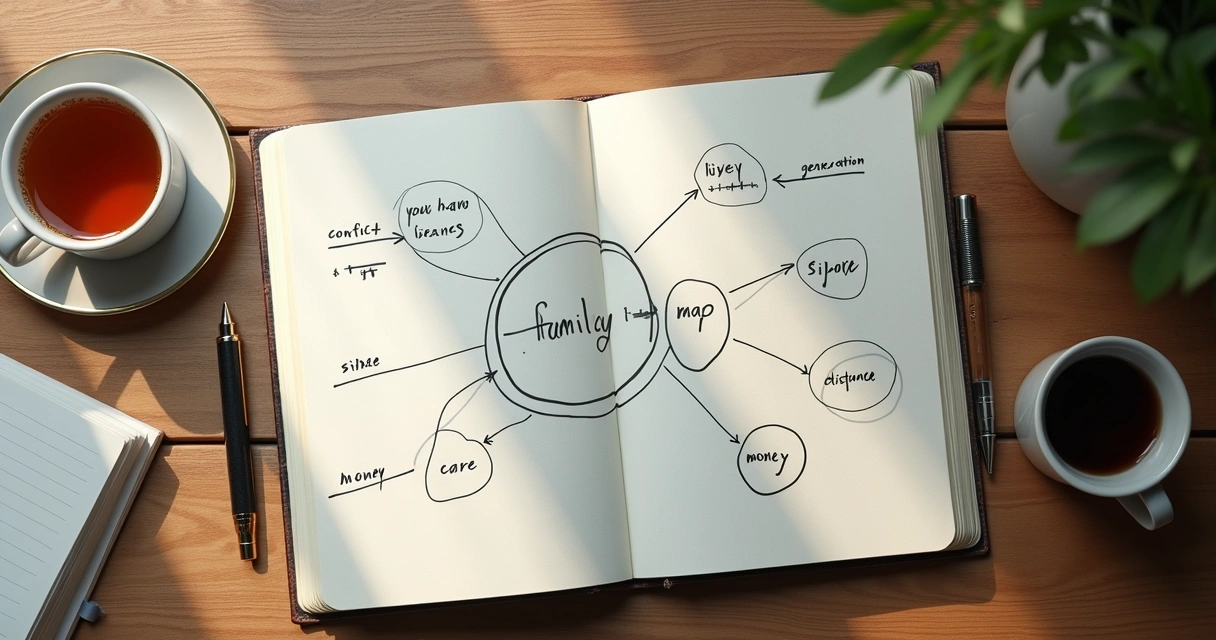
When we ask what repeats, we can look at patterns such as:
- Relationship breakups around similar conflicts
- Health issues tied to stress, silence, or overload
- Money habits shaped by guilt, fear, or secrecy
- Roles like caretaker, peacemaker, outsider, or hero
This kind of reflection fits well with broader conversations about consciousness, because repetition often starts below the level of clear awareness.
A pattern becomes easier to change when we can name its rhythm, not only its latest event.
Question two: Who had to carry too much?
Many generational patterns begin where someone carried more pain, duty, or sacrifice than they could process. A grandmother who lost a child and never spoke of it. A father who became an adult too early. A mother who learned that her needs were unsafe. These stories do not vanish. They often shape the emotional tone of the next generation.
We are not saying every burden becomes a pattern. Still, when suffering is not given language, it is often given behavior.
This question asks us to honor what happened without turning pain into identity. It helps us see whether our current reactions are fully ours, or partly inherited responses to unresolved strain.
Sometimes the family protects itself with one rule: do not talk. Other times the rule is: perform, please, achieve, endure. In both cases, a child may grow up feeling responsible for restoring balance.
That is why the path of integration matters so much. We cannot release what we refuse to recognize.
Question three: What was not allowed to be felt or said?
Every family has emotional permissions and prohibitions. In one home, grief is denied. In another, anger is punished. In another, tenderness is seen as weakness. Over time, these limits shape personality, attachment, and even life choices.
We have noticed that people often inherit silence before they inherit words. They learn what not to ask. They learn which truth would disturb the family order. Then they build a life around that invisible border.
We can pause here and ask:
- Was sadness welcomed or dismissed?
- Could children disagree safely?
- Was love shown with warmth or only through duty?
- Did anyone speak openly about loss, addiction, betrayal, or fear?
These questions support healing in relationships, because what is silenced in one generation often becomes conflict in the next.
What a family cannot feel directly, it may express indirectly through symptoms, tension, or distance.
Question four: What loyalties are shaping our choices?
This question can be surprising. A person may sabotage success out of hidden loyalty to a struggling parent. Another may stay in painful relationships because leaving would feel like betrayal. Someone else may reject joy because suffering was the family language of love.
These loyalties are rarely conscious. They can look noble on the surface. Yet they keep us tied to old contracts we never chose with full awareness.
We once heard a person say, “If I become lighter, I leave my family behind.” That sentence was quiet. Still, it carried a whole system inside it.
In families and teams alike, hidden loyalties also affect authority, belonging, and fear of standing out. This is one reason why reflection on leadership can be useful even in personal work. Many adults lead their lives from old loyalties instead of present truth.
Loyalty can heal. It can also bind.
Question five: What would change if we stopped compensating?
Compensation is a common family strategy. If one generation was chaotic, the next becomes rigid. If one was emotionally absent, the next becomes overinvolved. If one person collapses, another becomes hyper-responsible. These responses make sense. But they can create new suffering.
When we ask what would change if we stopped compensating, we move from reaction to choice. We stop living only against the past. We begin living from what is true now.
This question may lead us to simple but deep shifts:
- Setting limits without guilt
- Feeling grief without turning it into identity
- Accepting support instead of always rescuing
- Building intimacy without losing self-respect
If you want to keep reflecting on these themes in a wider way, we suggest using the site’s search resources to find related topics that match your present question.
Conclusion
When we ask systemic questions, we stop reducing pain to personality. We begin to see context, memory, and emotional inheritance. That shift alone can bring relief.
Healing generational patterns starts when we replace judgment with honest observation.
We do not need to accuse the past to become free from it. We need to see what was repeated, what was silenced, who carried too much, which loyalties still act in us, and where compensation has replaced presence. From there, a new position becomes possible. Not perfect. Not instant. But real.
And sometimes that is how a family story changes. One person pauses. One person asks a better question. One person refuses to pass pain forward in the same form.

Frequently asked questions
What are generational patterns?
Generational patterns are repeated emotional, relational, and behavioral tendencies that pass through families over time. They may appear in conflict styles, beliefs about love, money fears, silence around pain, or roles like caretaker and outsider.
How to identify family patterns?
We can identify family patterns by looking for repeated themes across generations. It helps to notice similar breakups, financial struggles, emotional habits, health stress, and unspoken rules. Asking relatives about family history can also reveal links that were not clear before.
Why do generational patterns repeat?
They repeat because people often adapt to unresolved pain without fully processing it. Children learn emotional rules early, then carry them into adult life. Hidden loyalty, silence, fear, and survival habits all help keep a pattern active.
How can I break negative patterns?
We break negative patterns by naming them clearly, feeling what was avoided, and making different choices in daily life. That may include setting limits, asking for support, speaking truth with respect, and refusing roles that keep old suffering in motion.
Are systemic questions effective for change?
Yes, systemic questions can support real change because they widen our view. Instead of asking only what is wrong with us, they ask what shaped us. This often reduces shame, increases clarity, and opens room for more conscious action.